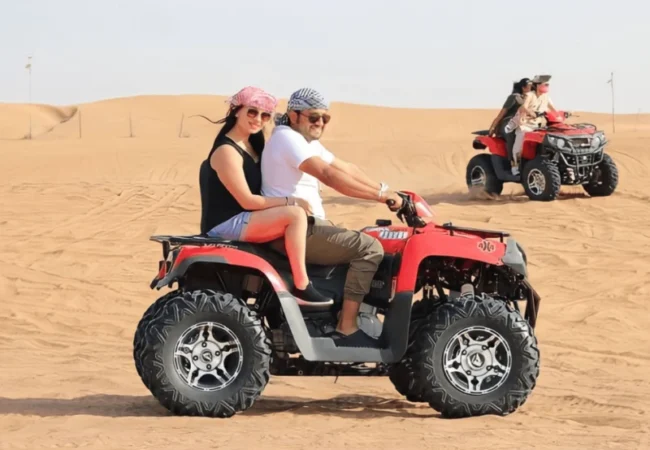
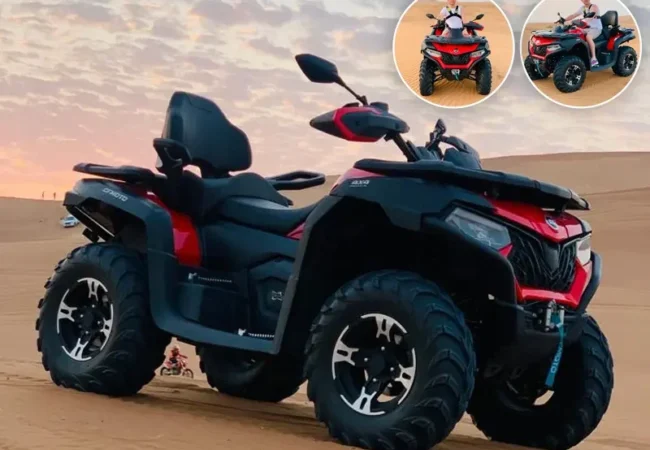
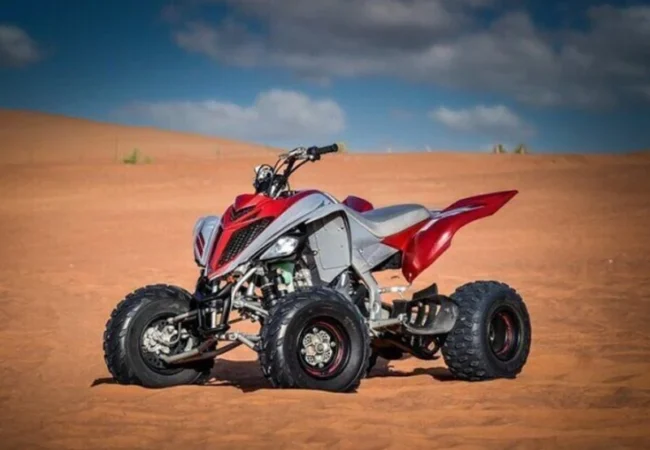
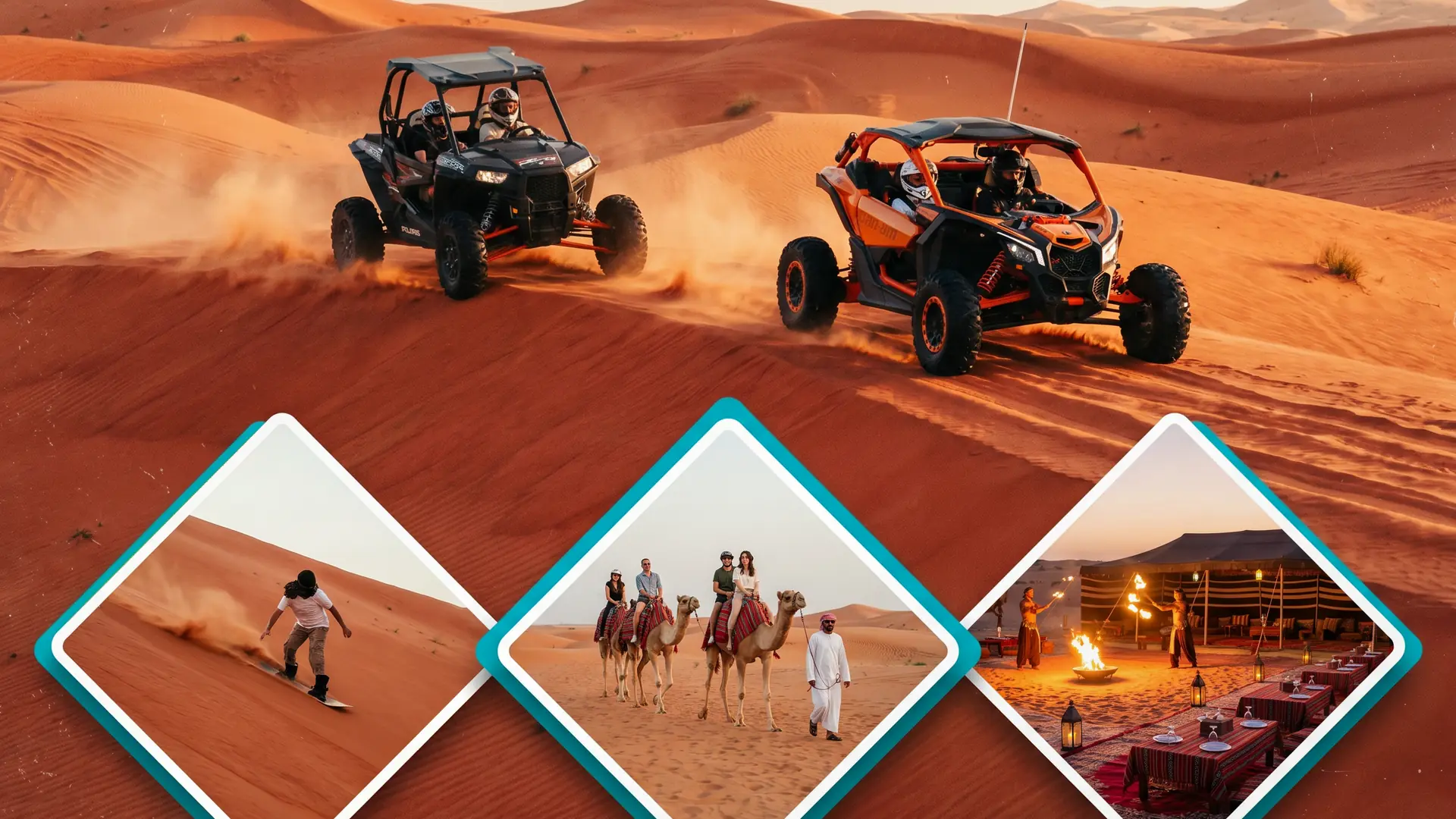
What actually makes a Can-Am Maverick X3 feel different from the rest of this fleet?
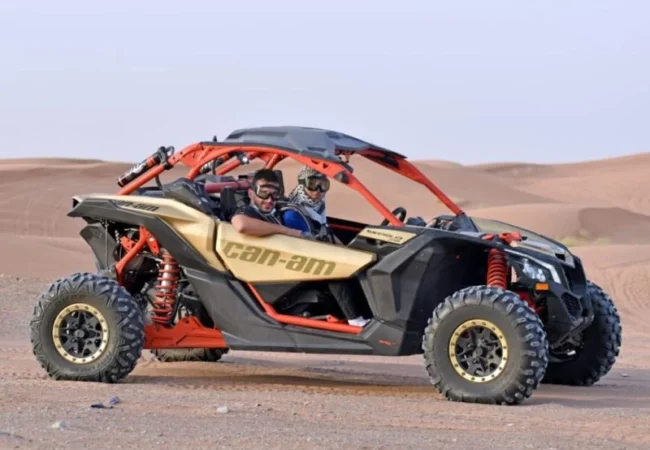
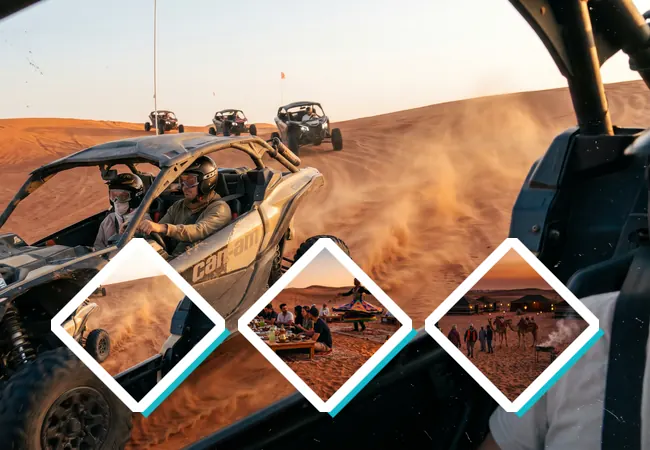
The short version: stance and suspension travel. The X3 sits wider than the Polaris RZR on this fleet and its wheels move through far more travel before the chassis feels anything, so rough ground that jolts a smaller buggy barely registers at the seat.
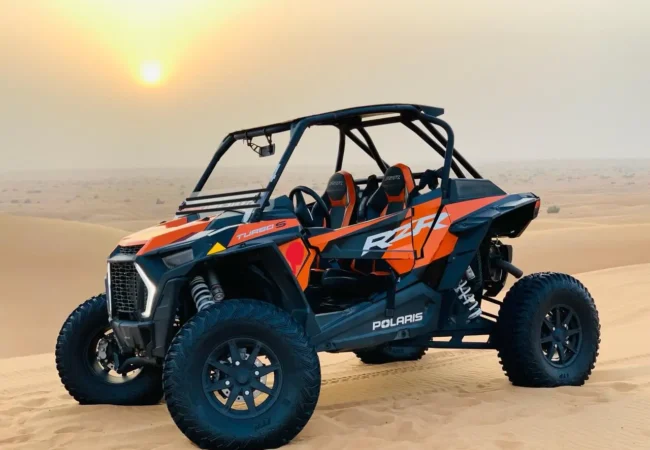
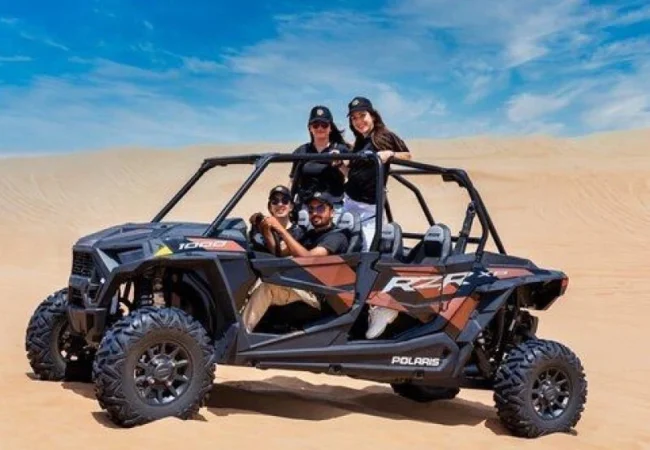
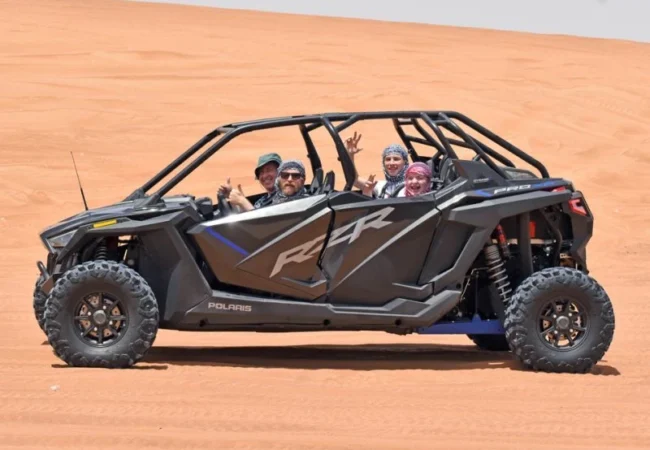
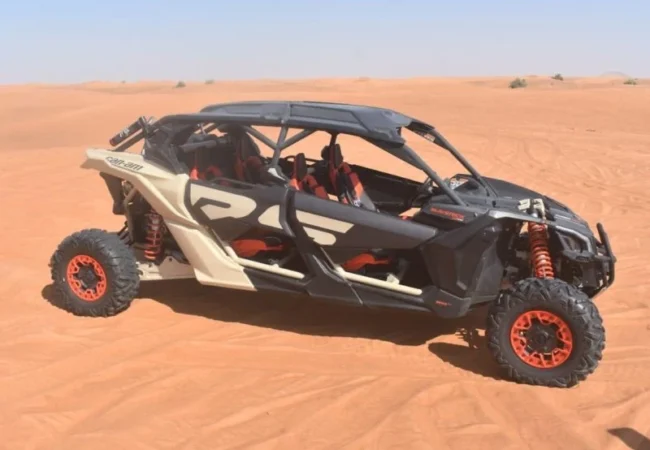
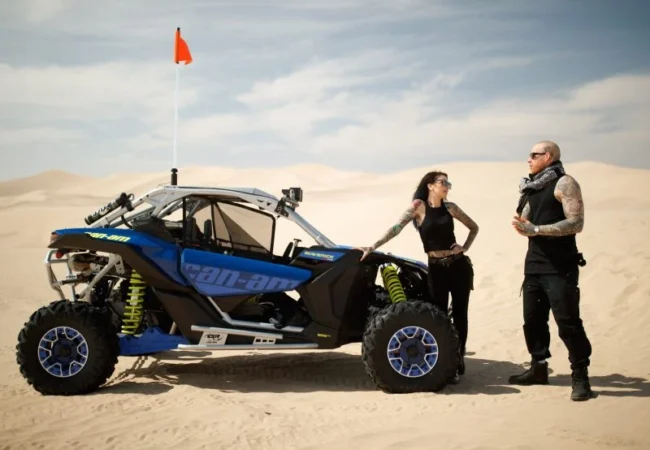
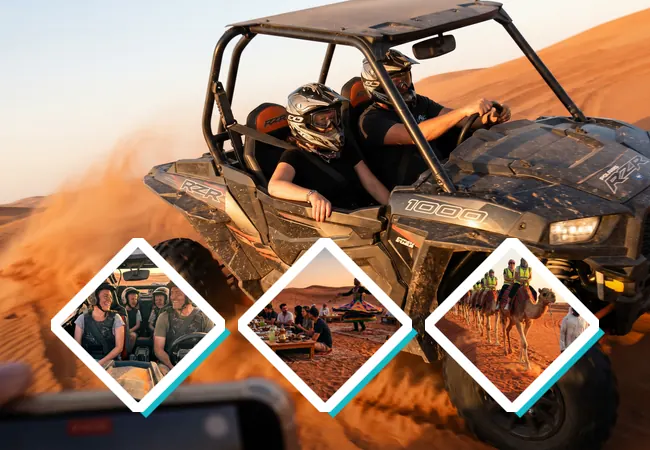
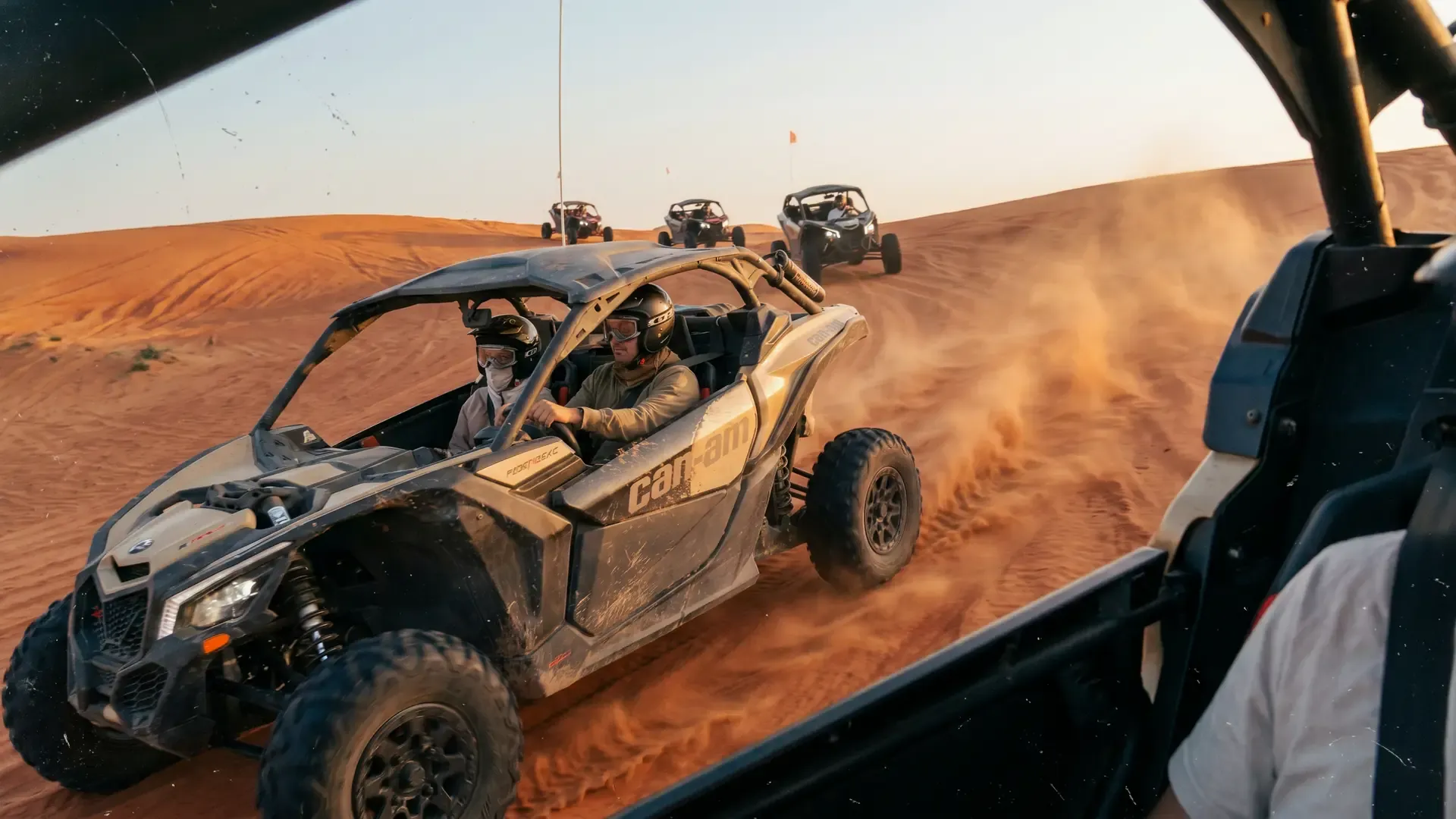
Park a Polaris RZR next to a Can-Am Maverick X3 and the width difference is visible before either machine moves. That extra stance isn't cosmetic — a wider wheelbase means the X3 leans less into a side slope and holds a line more confidently across uneven ground, which matters more on the folded, ridged terrain around Al Lahbab than it would on a flat gravel lot.
The bigger difference is underneath, in how much the suspension actually moves. Long-travel suspension lets each wheel absorb a bump independently instead of transmitting the hit straight through the frame and into your spine, which is the difference between a dune face feeling like a washboard and feeling like a wave. Riders who've only driven a standard buggy tend to describe the X3's ride the same way: smoother than expected, even when the terrain looks worse than what they just crossed on the Polaris.
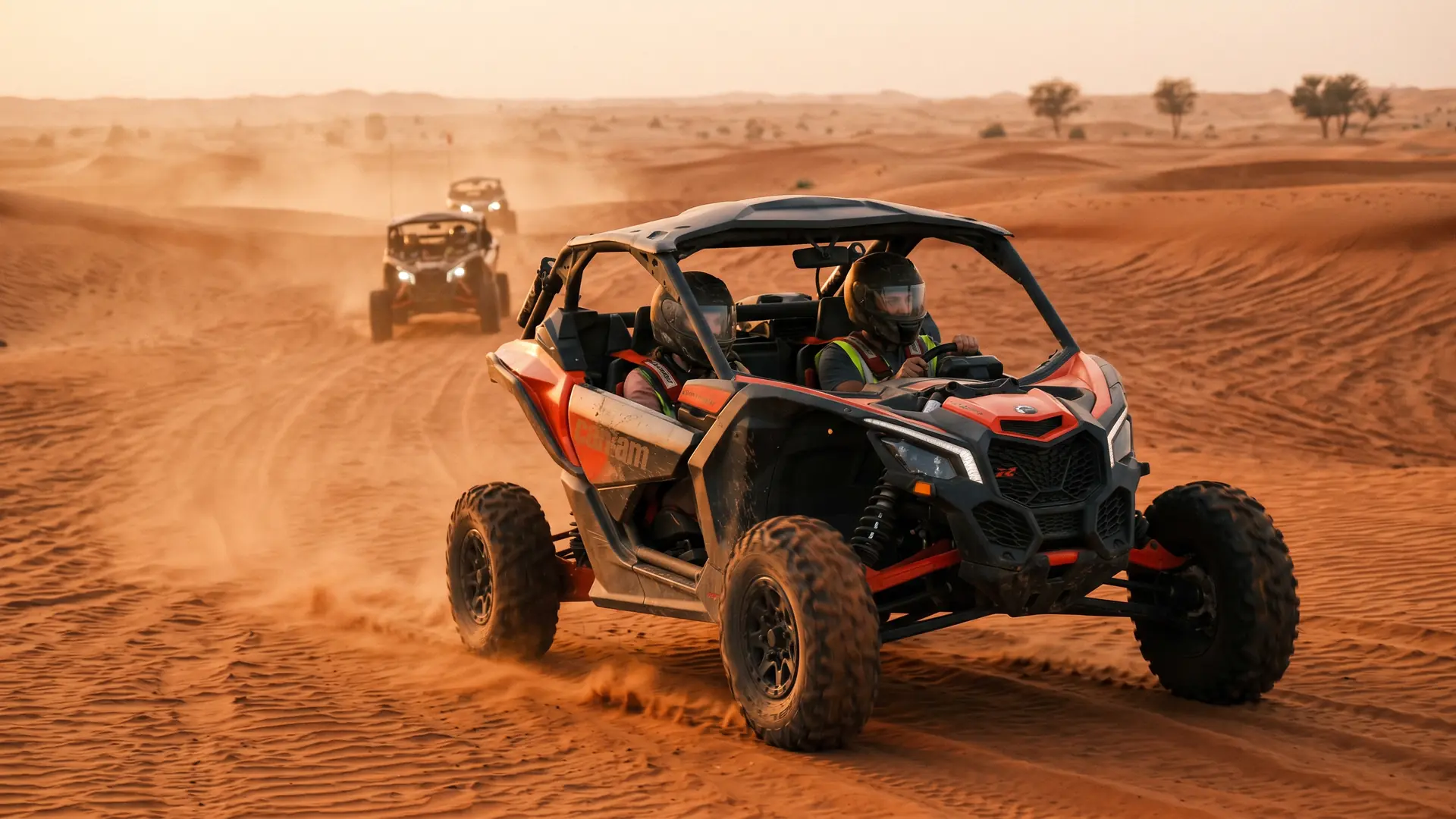
None of this makes the X3 a different sport. You still steer, brake and work the throttle the same way, and the guide still rides lead and calls the route. What changes is how much of the terrain actually arrives at your hands and seat — less on the X3, more on a smaller machine — which is exactly why riders who've tried both rarely go back to the smaller car once they've felt the gap.
Is the Can-Am worth the jump in price over the Polaris entry tier?
For a first 30-minute taster, probably not — the Polaris does the job for AED 599 and most first-timers can't feel the full gap in that short a session. Once you're booking an hour or more, or riding rougher terrain, the AED 999 X3 starts earning its price difference.
The honest answer depends on how long you're booking and what you've already driven. Thirty minutes on the warm-up loop and a short dune run doesn't give the X3's suspension much chance to prove itself over the Polaris — you'll notice the wider stance, but long-travel suspension needs rougher, longer ground to really show what it's for.
Where the upgrade earns its keep is on the hour-plus bookings, where the route opens into proper ridge lines and repeated dune faces. That's when the X3's extra suspension travel stops being a nice-to-have and starts meaning less fatigue by the end of the session, because your body isn't absorbing every bump the machine could have handled instead.
It's also worth the jump for anyone who's ridden a Can-Am, or a comparable wide-stance machine, somewhere else before and knows what they're missing on a smaller buggy. If you're brand new to buggies entirely, there's a real case for starting on the Polaris regardless of budget — learn the fundamentals on the more forgiving machine, then come back for the X3 once you know what you're doing with a wheel and a throttle in sand.
X3 or X3 RS Turbo RR: what does the extra tier actually buy you?
The base X3 (AED 999 to AED 1,200) is the wide-stance, long-travel machine most riders mean when they say Can-Am. The RS Turbo RR (AED 1,200 to AED 1,400) puts a turbocharged engine and 200hp on top of that same chassis, and it's the ceiling for most riders who book it.
Both tiers share the same underlying platform — the wide stance, the long-travel suspension, the general feel of the machine at low and moderate speed. What the RS Turbo RR adds is power, specifically a turbocharged engine putting out 200hp, which changes how the machine behaves once you're actually pushing it rather than cruising the standard route.
In practice, that power shows up in how fast you can close ground between dune faces and how much the machine wants to climb rather than labour. It also changes how the guide manages the group — spacing between RS Turbo RR machines tends to be wider than between standard X3s, simply because there's more speed available if a rider chooses to use it.
For most people booking a single session, the standard X3 is already a significant step up from Polaris and plenty of machine to enjoy properly. The RS Turbo RR makes the most sense for riders who've already driven the base X3 and specifically want more — a deliberate second step, not the tier most people should reach for on a first Can-Am booking. Still deciding between tiers? The chooser above breaks the same question down from a different angle.
Is the flagship Maverick R actually worth asking for a quote on?
For most people booking a session, no — the X3 range already delivers what you need. Sitting at 240hp, the flagship Maverick R only comes out on request, reserved for riders who've already earned it on the X3, which makes it less something you simply book and more something you work toward.
The Maverick R sits above the entire X3 range rather than beside it, which is why it isn't on the standard price table and doesn't get handed to anyone who asks for it cold. It's the machine guides mention when someone says they want the best on the fleet, and the answer is usually the same: prove it on the X3 first.
That policy isn't a sales tactic dressed up as caution. A 240hp machine rewards precision and punishes hesitation more than anything else here, and the fastest way to have a bad afternoon is to hand a rider more power than their throttle control can currently manage. Riders who've earned their way onto the R after a session or two on the X3 consistently describe it as a different level again, not just a faster version of the same thing.
If you're planning a trip specifically to drive the flagship, the realistic move is to book the X3 first, tell the team that's the goal, and ask about availability for the R on the same trip or the next one. Nobody who follows that order regrets it, and it's the only route to actually getting the keys.
Do you need more experience to handle a Can-Am than a Polaris?
Not for the base X3 — it's forgiving enough for a confident first-timer once they've cleared the warm-up loop. The RS Turbo RR and the Maverick R are a different story, and both are reserved for riders who've already handled a buggy in sand.
The X3 2-seater and 4-seater don't require prior off-road experience any more than the Polaris does. The warm-up loop on flat ground before every session is what actually decides how much dune you get, not which brand you booked, and guides send first-timers out on the base X3 regularly once they've seen enough control during that loop.
The gap opens up at the turbo tiers. The RS Turbo RR's extra power means a small input mistake has bigger consequences at speed, so guides ask for prior sand-driving experience before releasing it, and the Maverick R goes a step further, released only to riders who've already proven themselves on the X3 specifically. That's a safety filter more than a marketing one — power without judgment is where people get stuck or overcorrect, on any brand.
If you're unsure where you fit, say so honestly when you book. The team would rather put a nervous first-timer on the Polaris or the base X3 and have them enjoy it than send someone underprepared out on the RS Turbo RR because they didn't want to admit it was their first time.
How does Can-Am's off-road racing heritage show up in how the X3 drives?
Can-Am is built by BRP, the Canadian company also behind Ski-Doo and Sea-Doo, and BRP runs factory-backed teams racing the X3 platform in professional off-road competition. That racing programme is where a lot of the suspension and chassis engineering in your rental buggy actually comes from.
It's easy to dismiss racing heritage as marketing dressed up as fact, but in this case it shows up in specific, feelable ways. The wide stance and long suspension travel that make the rental X3 comfortable over rough sand are the same engineering priorities that matter in competition, where a chassis that skips or bottoms out costs a team a race. Rental buggies aren't race cars, but the platform underneath them is descended from the same design thinking.
You notice it most on the terrain that would upset a smaller machine — a rutted transition between two bowls, a washboard patch on a climb, the kind of ground a race-bred suspension is specifically built to shrug off rather than pass on to the driver. That's the part of the X3's reputation that isn't just brand storytelling: BRP's off-road racing programme has spent years refining exactly that.
None of this means a rental session turns into a race. The route, the guide and the speed are all managed the same way regardless of which machine you're on. What the racing heritage buys you is a chassis engineered for rough terrain from the start rather than adapted to handle it afterward — and that engineering is available on your very first booking, not just to the professionals.
Searched for Can-Am specifically? Here's what to know before you book.
You've got five machines to choose from, not one: the X3 2-seater and 4-seater from AED 999, the RS Turbo RR 2-seater and 4-seater from AED 1,200, and the 240hp Maverick R on request. Say Can-Am when you message on WhatsApp and the team will ask about your experience level to match you to the right tier.
If you searched for Can-Am by name rather than just "dune buggy Dubai," you probably already know roughly what you want, so it's worth being specific when you book rather than leaving it to chance. Say which tier you want by name — the standard X3, the RS Turbo RR, or the Maverick R if you've genuinely earned it — and mention your sand-driving background, since that's the detail deciding which set of keys the guides are comfortable handing over.
It's also worth knowing this fleet runs Polaris alongside the Can-Am line, so you'll see Polaris machines in the fleet section above and on the price table even on a page built around the Can-Am search. That's not a bait-and-switch: the Polaris RZR is the cheapest entry point onto any buggy here, at AED 599, and genuinely the better choice for a first-timer who isn't sure yet whether they want to commit to the Can-Am tiers.
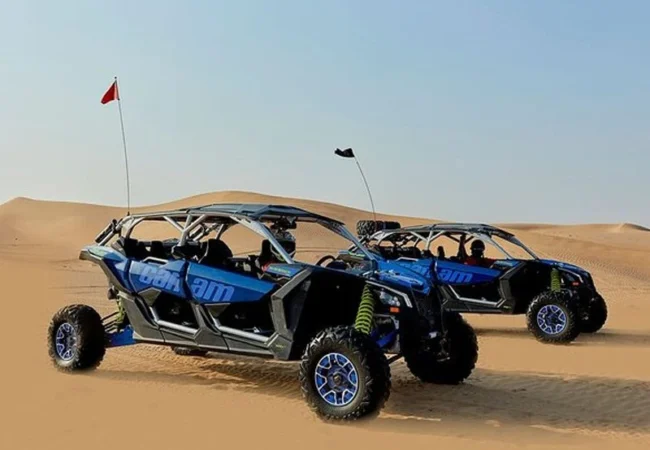
The X3 and X3 RS Turbo RR both come in 2-seater and 4-seater builds, so bring the whole group's headcount when you message, not just your own preference. Weekends move fastest for the Can-Am 4-seaters and the RS Turbo RR specifically, so naming your machine a few days ahead rather than turning up and hoping is the difference between getting it and getting whatever's left.
People also search for
Guide FAQ
Does the Can-Am X3 actually feel different, or is that just marketing?
It's not just marketing. Put a Polaris and an X3 back to back over the same stretch of chop and the gap is obvious inside a few seconds — the X3 sits wider, the wheels travel further before the chassis feels anything, and rough patches that jolt a smaller buggy barely register. Guides notice riders relax on the X3 faster than on any other machine here, purely because it absorbs mistakes the Polaris would pass straight through to your spine.
Can I test the Can-Am for a few minutes before committing to a longer booking?
Not as a separate test slot, but the warm-up loop does the same job. Every booking, 30 minutes or three hours, starts with circles on flat ground before the dunes, and that's genuinely enough seat time to feel the difference in stance and ride quality. If you're still unsure afterward, say so — the guide would rather move you to a Polaris than send you out uncertain.
Is the Maverick R actually a different machine, or just a pricier X3?
It's a different machine, not just a pricier badge on the same platform, which is why it's kept off the standard price list and quoted on request instead. The R sits above the RS Turbo RR in the lineup and is only released to riders who've already proven themselves on the X3. If you haven't driven the X3 yet, that's the one to book first regardless of budget.
Do Can-Am buggies need more maintenance than the Polaris machines?
Not from where you're sitting as a renter — every machine on this fleet, Can-Am or Polaris, gets the same pre-ride inspection in front of you before you climb in. What's true is that the X3's turbo variants get more attention between sessions simply because they're pushed harder, which is exactly why the RS Turbo RR and the Maverick R are the two machines guides are pickiest about handing over.
Why do some Dubai operators only offer Polaris and not Can-Am?
Cost and demand, mostly. Can-Am machines sit at a higher price point to buy and maintain, so smaller operators standardise on Polaris alone rather than run two brands side by side. Running both means guides need to actually know the handling differences between them, which is part of why the briefing here covers brand as well as machine size.
Is a Can-Am harder to control if I panic on a steep dune?
If anything the wider stance makes it more forgiving in that exact moment, not less. What actually gets a buggy stuck or tipped is throttle discipline, not the badge on the hood — easing off halfway up a climb, or turning across a face instead of committing to it. That's true on a Polaris or a Can-Am, which is why the warm-up assessment is about your inputs, not which brand you asked for.
Can I request a specific Can-Am, like the X3 4-seater, by name?
Yes, and it gets held for your slot once your booking is confirmed. The X3 4-seater and the RS Turbo RR are the two that go first on weekends, so naming your machine when you message on WhatsApp is worth doing rather than turning up and hoping one is free.
Does Can-Am's racing background actually matter for a 30-minute rental?
It shows up more than you'd expect for something this short. BRP, the company behind Can-Am, has spent years running side-by-sides in off-road competition, and the suspension and chassis work that comes out of that programme is what ends up in the X3 you're driving here — not a race car, but a rental buggy built by people who test the platform somewhere far rougher than Al Lahbab.
Should a nervous first-timer book the Can-Am or stick with Polaris?
Stick with Polaris for a first booking. It's not that the Can-Am is unsafe, it's that learning the basics on the more forgiving machine beats managing extra width and power at the same time. Plenty of nervous first-timers come back within the month specifically to try the X3 once they know what they're doing.
Is it worth paying more for the Can-Am if I'm only booking 30 minutes?
Thirty minutes is short enough that many riders don't notice a huge difference, so the Polaris entry rate is a perfectly reasonable way to spend it. The Can-Am's advantages — the suspension travel, the planted feel on rough ground — show up more clearly over an hour or two, once you're covering enough terrain to actually load the suspension repeatedly. If budget is tight, put the extra toward a longer Polaris session rather than a short Can-Am one.
 AED 599